
Artificial intelligence (AI) is transforming the way businesses attract, engage, and retain customers online. From automated content creation to predictive analytics and personalized advertising, AI has become an important part of modern digital marketing. As technology continues to evolve, understanding the future of AI in digital marketing is essential for marketers and businesses that want to remain competitive.
What Is AI in Digital Marketing?
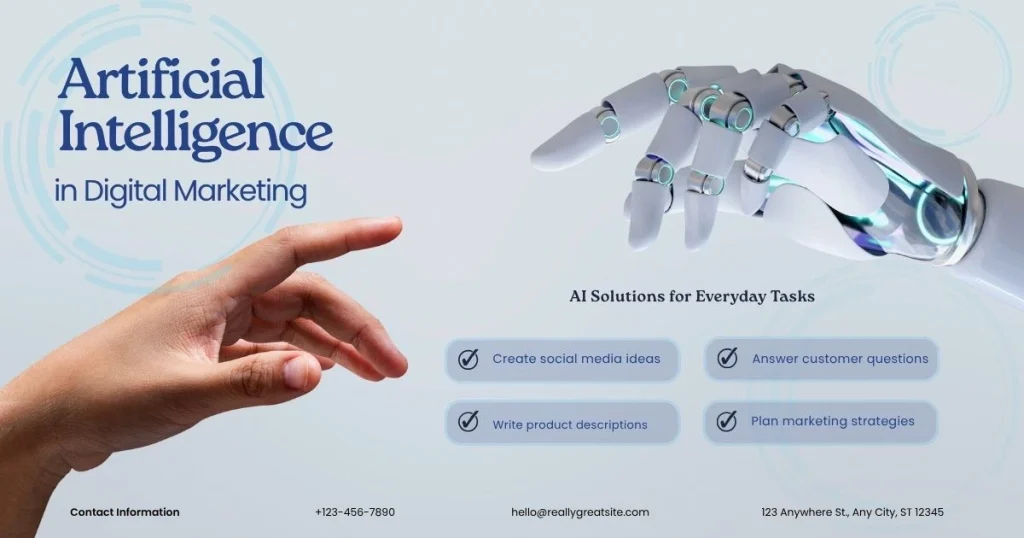
AI in digital marketing refers to the use of artificial intelligence technologies to analyze data, understand customer behavior, automate marketing activities, and improve decision-making. AI-powered platforms can process large amounts of information much faster than humans, helping marketers create more relevant and effective campaigns.
AI is already used for content creation, keyword research, customer segmentation, chatbots, email marketing, social media management, advertising optimization, and predictive analytics.
How Is AI Changing Digital Marketing?
AI is changing digital marketing by making campaigns more personalized, automated, and data-driven. Instead of relying only on traditional methods, marketers can use AI to identify patterns in customer behavior and predict what audiences are likely to do next.
For example, AI can analyze browsing behavior and previous purchases to recommend products that are relevant to individual customers. It can also help businesses determine the best time to send emails, identify high-value audiences, and optimize advertising campaigns.
The future of digital marketing in the AI era will therefore focus increasingly on combining human creativity with intelligent automation.
Future of AI in Digital Marketing: Key Trends for 2026
1. Hyper-Personalized Marketing
One of the biggest future trends of AI in digital marketing is hyper-personalization. AI can analyze customer preferences, interests, search behavior, and purchase history to deliver highly relevant content and advertisements.
Businesses can use AI solutions for hyper-personalized digital ad campaigns, product recommendations, and customized customer experiences.
2. AI-Powered Content Creation
AI platforms can generate marketing copy, social media captions, email drafts, blog outlines, and other marketing content within seconds. However, human marketers remain important for strategy, creativity, brand voice, fact-checking, and emotional storytelling.
The future is likely to involve collaboration between AI tools and human marketers rather than complete replacement of human creativity.
3. Voice Search and AI Search
Search is also changing rapidly through AI-powered search engines, conversational interfaces, and voice assistants. Marketers need to create content that directly answers user questions and reflects natural language.
AI prompts, voice search optimization, conversational content, and answer-focused content will become increasingly important for SEO and digital marketing strategies.
4. Predictive Analytics
AI-powered predictive analytics can help marketers forecast customer behavior, identify potential leads, predict sales trends, and optimize campaigns.
This allows businesses to move from simply analyzing what happened in the past to predicting what may happen in the future.
5. Automated Social Media Marketing
AI is making social media management more efficient by helping marketers generate content ideas, analyze engagement, identify trends, schedule posts, and understand audience behavior.
AI-powered social media solutions can reduce repetitive tasks and give marketers more time to focus on strategy and community building.
6. AI-Powered Customer Segmentation
AI can transform customer segmentation by analyzing multiple data points simultaneously. Instead of placing customers into broad categories, businesses can create more precise audience groups based on behavior, interests, demographics, and purchasing patterns.
This can improve targeting and reduce wasted advertising spending.
Pros and Cons of AI in Marketing
AI offers several benefits, including faster content production, improved personalization, automation, better data analysis, and more efficient marketing campaigns.
However, there are also challenges. Overdependence on AI can result in generic content, inaccurate information, privacy concerns, and reduced human creativity. Successful marketers will need to use AI responsibly while maintaining human oversight.
How Will AI Change Digital Marketing Jobs?
AI is unlikely to simply eliminate digital marketing professionals. Instead, it will change their roles. Marketers will increasingly need skills in AI prompting, data analysis, strategy, content editing, automation, SEO, and AI-assisted campaign management.
The marketers who learn how to work effectively with AI tools may have a strong advantage in the future job market.
The Future of AI in Digital Marketing
The future of AI in digital marketing is centered around automation, personalization, predictive analytics, conversational search, and intelligent decision-making. Businesses that adopt AI strategically can improve customer experiences while saving time and resources.
However, AI should be treated as a tool rather than a complete replacement for human expertise. The strongest digital marketing strategies will combine AI’s ability to analyze and automate with human creativity, empathy, critical thinking, and strategic decision-making.
As we move further into 2026 and beyond, learning how to use AI effectively will become an increasingly valuable skill for every digital marketer.
Frequently Asked Questions
What are some AI in marketing examples?
Common examples include AI chatbots, personalized product recommendations, automated email campaigns, AI-generated content, predictive analytics, customer segmentation, and automated advertising optimization.
What AI platforms generate marketing copy?
Platforms such as ChatGPT, Google Gemini, Claude, and other AI writing tools can assist marketers with generating marketing copy, headlines, social media content, email drafts, and blog ideas.
What are the best AI tools for keyword research and content optimization?
AI-assisted SEO platforms can help with keyword research, content analysis, search intent, topic research, competitor analysis, and content optimization. The best tool depends on the marketer’s specific requirements and budget.
How can AI improve email marketing performance?
AI can help personalize email content, segment audiences, predict the best sending times, recommend products, and analyze campaign performance. These capabilities can help businesses create more relevant email campaigns.
What are the pros and cons of AI in marketing?
The main advantages include automation, personalization, faster analysis, and improved efficiency. Challenges include inaccurate outputs, privacy concerns, generic content, and overdependence on automation.
Where can I learn AI marketing skills?
Digital marketing professionals can learn AI marketing through online courses, professional certifications, practical projects, and specialized AI and digital marketing training programs. Building practical experience with AI tools is equally important.
What is the future of AI in marketing?
The future of AI in marketing will increasingly involve hyper-personalization, predictive analytics, automated campaigns, AI-powered search, voice search, intelligent customer segmentation, and collaboration between AI systems and human marketers.
Pingback: What Is Performance Marketing? | AishaNiha Guide
Pingback: What Is SEO in Digital Marketing? | AishaNiha Guide